logo
خانه

وبلاگ در باره Laser Cooling Advances Principles and Modern Applications

گواهی
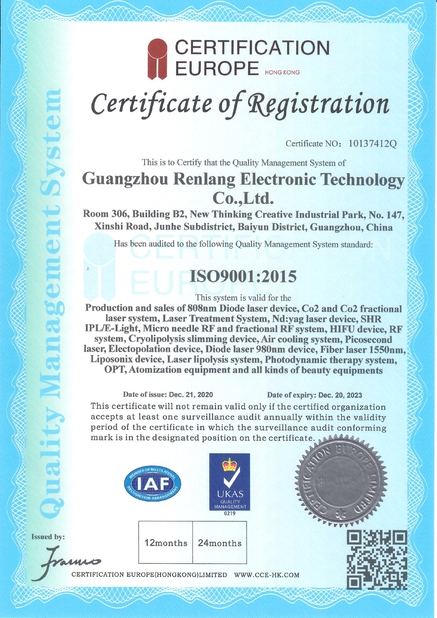
چین Guangzhou Renlang Electronic Technology Co., Ltd. گواهینامه ها
چت IM آنلاین در حال حاضر
شرکت وبلاگ
Laser Cooling Advances Principles and Modern Applications
آخرین اخبار شرکت Laser Cooling Advances Principles and Modern Applications

Imagine using light to "capture" and slow down the movement of atoms. What might sound like science fiction is actually the core principle behind laser cooling technology. This revolutionary technique leverages the interaction between light and matter to "freeze" atoms and molecules to near absolute zero temperatures, unlocking unprecedented possibilities in quantum physics, precision measurement, and beyond.

The Quantum Dance: How Laser Cooling Works

Laser cooling represents a widely-used technique in atomic physics and quantum optics designed to reduce the movement speed of microscopic particles like atoms and molecules while confining them to specific areas. The fundamental principle relies on the elegant transfer of momentum between photons and atoms.

When an atom absorbs a photon, it gains energy and jumps to a higher energy level. Subsequently, the atom spontaneously re-emits the photon and returns to a lower energy state. The key to laser cooling lies in controlling the direction of photon re-emission to oppose the atom's movement. Through repeated absorption and emission cycles, atoms gradually lose momentum, slowing down until reaching ultra-cold states where they can be trapped in optical lattices.

Core Mechanisms: Momentum Transfer and Doppler Effect

The essence of laser cooling involves precise control over light-atom interactions to achieve effective momentum transfer. While a single photon carries minimal momentum, the cumulative effect of thousands of these interactions can significantly reduce atomic velocities.

The Doppler effect plays a crucial role in selective cooling. As atoms move toward a laser beam, they perceive a slightly higher frequency due to their motion. By tuning the laser frequency slightly below an atom's resonant frequency, the system preferentially slows atoms moving toward the light source while minimally affecting those moving away.

Advanced Cooling Techniques
  • Doppler Cooling: The workhorse for neutral atoms, achieving temperatures in the millikelvin range through carefully tuned laser frequencies from multiple directions.
  • Zeeman Slower: Combines magnetic fields with lasers to create an "atomic brake" that produces slow-moving atomic beams for subsequent cooling stages.
  • Sisyphus Cooling: A sophisticated approach for ions where particles continuously "climb" potential hills in laser fields, losing kinetic energy in the process and reaching microkelvin temperatures.
  • Polarization Gradient Cooling: Breaks through Doppler limits using counter-propagating lasers with orthogonal polarizations to create complex energy landscapes that enable more efficient cooling.
  • Sub-Doppler Cooling: Leverages quantum interference effects to reach temperatures below conventional Doppler limits.
  • Resolved Sideband Cooling: Targets specific vibrational modes of trapped ions, making it indispensable for quantum information processing.
Scientific Applications
  • Ultracold Atoms & Bose-Einstein Condensates: Enables macroscopic quantum phenomena where thousands of atoms coalesce into a single quantum state, providing ideal platforms for studying fundamental physics.
  • Optical Traps: Allows precise manipulation of individual atoms or molecules for applications in biophysics and materials science.
  • Atomic Clocks: Powers the world's most precise timekeeping devices by minimizing atomic thermal motion, with critical applications in navigation and communications.
  • Quantum Computing: Provides stable quantum bits (qubits) using ultracold atoms or trapped ions as the foundation for next-generation computing.
  • Precision Measurements: Enhances the accuracy of fundamental constant measurements and physics theory validations by reducing thermal noise.
Technical Requirements
  • Wavelength Precision: Must precisely match atomic transition frequencies, typically requiring visible or near-infrared lasers.
  • Power Output: Requires sufficient intensity to counteract thermal motion, typically ranging from milliwatts to several watts.
  • Spectral Purity: Needs exceptionally narrow linewidths to avoid off-resonance interference.
  • Stability: Demands ultra-low noise and frequency stability to maintain consistent cooling performance.
  • Beam Quality: Requires well-defined spatial profiles for precise atomic confinement and manipulation.
میخانه زمان : 2026-02-05 00:00:00 >> blog list
اطلاعات تماس
Guangzhou Renlang Electronic Technology Co., Ltd.

تماس با شخص: Mr. Frank

تلفن: +8613826474063

ارسال درخواست خود را به طور مستقیم به ما (0 / 3000)